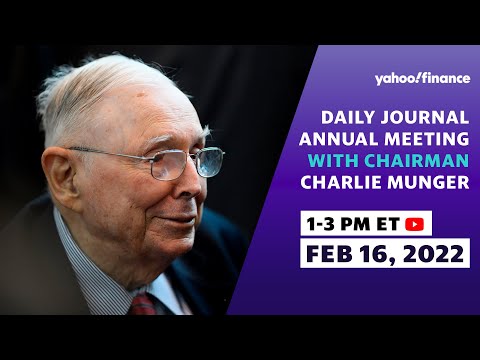
Rough auto-transcript (machine-generated)
Auto-generated from YouTube captions and lightly cleaned — punctuation and proper names
may be off. We don’t own this; all rights belong to Daily Journal / Yahoo Finance.
Source ↗
Hello and welcome. You're watching Yahoo Finance Live for this special exclusive coverage of the Daily Journal's annual meeting of shareholders. I'm Julia La Roche coming to you from Miami, Florida. I'm now going to send things over to Los Angeles where we have the Daily Journal's CEO Jerry Salzman and Charlie Munger, chairman of the board for some opening remarks before the shareholder questioning begins. Charlie, the floor is yours. As usual, we'll go through this formal agenda very rapidly and then we'll stay here and answer questions for a very long time. The questions have all been submitted by actual shareholders of the Daily Journal and Yahoo's just delivering them to us. Ladies and gentlemen, wherever you are by a Yahoo Finance's website. The meeting will come to order. I'm Charlie Munger, chairman, and to my right is Jerry Salzman, CEO. It's pe- What's all this list of directors for? Just to let the people know who the directors are, Charlie. Well, the directors are Jerry Salzman, Peter Kaufman, Mary Conlon, and Gary Wilcox, who's retiring now, and myself. Ellen Ireland will be inspector of elections. We will now propose to make formal to the formal business of the meeting. On December 18th, 2020, the record date, there were 1,380,746 shares of common stock of the company outstanding. The total number of shares represented by proxies at this meeting are 995, 682, which are more than enough to constitute a quorum making the meeting duly held. The first order of business is to reelect the four directors. And the votes are as follows: Charles Munger, 679,481. Gerald Salzman, 662,87. Peter Kaufman, 593,336. Mary Conlon, 651,450,493. Because we have the proxies, those directors are now reelected. The second proposal is to ratify the appointment of our certified public accountant. Baker Tilly US LLP. And we The votes in favor of that are for 995,356 and against 120. It's interesting. You know who in the hell is voting against the accountants? But the accountants are duly elected. And we will now proceed to the question period. Go ahead. Thank you, Charlie. Our first question comes from Michael Wong. Michael Wong asks, "In this year's annual letter, you mentioned the share price increase was driven by speculative frenzy and forced index buying. I would imagine that applies to the broad market, too. What are the psychological implications of this type of market behavior? What could investors do to cope better with periodical frenziness?" Well, these things do happen in a market economy. You get crazy booms. Remem- remember the dot-com boom? When every little building in Silicon Valley rented at a huge price and a few months later they were about a third of them were vacant. Uh there are these periods in capitalism and I've been around for a long time and my policy's always been to just ride them out. And I think that's what shareholders do. In fact, what shareholders actually do is a lot of them crowd in to buying stocks on frenzy frequently on credit because they see that they're going up. And of course that's a very dangerous way to invest. Uh I think that shareholders should be more sensible and not crowd into stocks and just buy them just because they're going up and they like to gamble. And of course gambling runs through the famous poem called The Women. And he then the concluding line was uh to the effect that you should learn about women from him instead of do your- yourself, but he says I know you won't follow my advice. Go ahead. Next question. Thanks, Charlie. Our second question, we have a couple of shareholders who are asking about this latest retail uh frenzy. Um so we have Gavin Smith who asks, "What are Mr. Munger's thoughts on the recent GameStop short squeeze by social media and the resulting implications on short selling in the future?" And another shareholder named Lee asked, "Dear Mr. Munger, please share your thoughts on the recent Wall Street Bets GameStop squeeze. It seems to involve a lot of your standard causes of human misjudgment." Well, it certainly does and uh that's the kind of thing that can happen when you get a whole lot of people who are using liquid stock markets to gamble the way they would on in betting on race horses. And that's what we have going in the in the uh stock market and then and the frenzy is fed by people who are getting uh commissions and other revenues out of this new bunch of gamblers. And of course uh when things get extreme, you have things like that short squeeze. It's not generally noticed by the public, but clearing houses clear all these trades. And when things get as crazy as they were in the event you're talking about, uh there are threats of clearing house failure. So it gets very dangerous and it's really stupid to have a culture which uh encourages as much gambling in stocks by people who have the mindset of race track race track bettors. And of course it's going to create trouble as it did. And I have a very simple idea on the subject. I think you should try and make your money in this world by selling other people things that are good for them. And if you're selling them gambling services where you rate profits off the top like many of these new brokers who specialize in luring the gamblers in, I think it's a dirty way to make money and I think that we're crazy to allow it. Next. Our next question comes from Andrew Wilkinson. He would like to know, "What do you hope the future of the Daily Journal Corporation looks like in a decade?" Well, I certainly hope that they succeed mightily in their software endeavor to automate all these courts for the modern world. And uh and I think that could happen, but of course it's not a sure thing. I hope the newspapers survive, too, and that's not a sure thing, either. Dear Mr. Munger and Mr. Salzman, this question comes from Matthew Peterson, I should mention. He writes, "The highly configurable JTI product may help e-suites integrate deeply into new jurisdictions as agencies and citizens become familiar with the courthouse software. Today, the majority of contractual revenue that can be identified is from implementations and licenses. What are the main sources of ancillary revenue expected once the products have gone live and how meaningful will the products like e-filing, e-pay it, cloud hosting services, and others become. Well, we don't really know where it's all going. We do know one thing, and that is the courts of the whole world are going to be taken into the modern age. And as Jerry just said to me at break just after breakfast, you wouldn't want to invest in a parking lot by a courthouse for the future because an awful lot of the court proceedings are going to go to the internet. And this is a highly desirable thing. And if you go to a little country like Estonia, the whole damn company the country is on the internet, and it's a very good idea. So, I think you can count on the fact that what we're doing is going to be a it's a big growing field. That's the good news. The bad news is it's not clear who's going to win. all the business or how much money is going to be made. Generally speaking, people assume that we're a normal software company like Microsoft or something. We are in fact in a more difficult type of the software business than Microsoft. We respond to software by the RFP process. It's a very difficult, demanding business, and it's less profitable unless you're than what Microsoft does. But we love it anyway. It's doing a big public service. Go ahead. All right. Our next question, uh we had a couple questions about um J.P. Rick Guerin. Uh we have Tom Seemore and Thomas Chang both asking um if you all would share a few stories about him and your fondest memory. Well, I always I Of course, I'm He was one of my closest friend for many decades. And he was very good company. And a splendid gentleman, and of course, we accomplished quite a bit working together. Rick was part of the group which consisted of Warren Buffett, Rick Guerin, and Charlie Munger that bought control of Blue Chip Stamps when it was widely distributed as in an antitrust settlement. And we were together in that for a long, long time, and then Rick and I did the Daily Journal together at another occasion. And Rick was always humorous, always intelligent. I tell a story on Rick that he took the Navy's IQ test and he got the one of the highest scores ever recorded and left early. And that doesn't happen. That's the reason he rose so fast in life. He was just so damn smart. And of course, he was fun to be with cuz he was always jumping out of airplanes and parachutes and running marathons and so on doing all kinds of things I would never consider doing. And he was a lot of fun to And he was a great kidder. He loved to kid people. And of course, he was very courageous and generous in helping everybody around him all his life. He was an abso- We miss Rick terribly. But he was 90 years of age. He had a long and wonderful run. And of course, he When you're as old as I am, when these people go, you there's no replacing them. Jerry, can you ever remember Rick down? He was always upbeat. Always upbeat, yes. And interested and up to speed and didn't have to take a lot of time to get background information to make his comments. Always on point. Well, it helps to be able to leave the IQ test early with the highest score. Our next shareholder question is from Adam Smith from Muncie, Indiana. He asked, "Now that we are cash flow positive, assuming the software business is investing organically as much as it can, what is the philosophical thinking with respect to capital allocation at the Daily Journal? Are traditional dividends and share repurchases the likely end state, assuming our software business grows into a bonafide company, or will buying and holding securities from time to time be what the board is comfortable with? Everyone knows this isn't a small cap Berkshire Hathaway. Just trying to get a feel for what the long-term capital allocation is." Well, our the business around here that has the most promise is our software business automating the courts. And we're going to play that as hard as we can. And we hope to do well in it. And our marketable securities are just a We prefer owning common stocks to holding cash in under current conditions. And it's kind of an accident that we have so much in marketable securities. We had a couple of questions um around succession planning. We have one from Ryan Fusaro from New York City. Uh Charlie, he writes, "In recent years, Berkshire Hathaway has provided much greater insight into the company's succession thoughts and has made available at the annual meeting the company's leading managers that will steer Berkshire's future. These actions have given some shareholders more visibility and comfort on their investment. Can you provide similar insight regarding the future at the Daily Journal, and would you consider implementing policies like those at Berkshire so shareholders can get to know the up-and-coming leaders in the organization?" Well, the people doing the computer software are doing magnificently well, the people under Jerry, Mary Joe and Danny. And we hope they'll continue doing magnificently well. But of course, it's a very difficult field, and there's a lot of competition, and we're a very small company compared to the our main competitor. And so, we can't promise we're going to succeed. All we can promise is we're going to try. And so far as I can tell, we're doing pretty well. Jerry, don't you think we're doing pretty well? I think so, Charlie. Yeah. I would go further. I don't think Jerry is surprised that the people doing the work, Mary Joe and Danny, are doing well. But I'm flabbergasted at how well they're doing. Charlie refers to the courts many times. The JTI software has been configured for other judicial and justice agencies, including district attorneys, prosecutors, public defenders, probation, etc. So, we have one basic system configured a number of different ways, including workers' comp for a large state in the United States. Well, it's a huge field in which we have a very interesting toehold with the strongest toeholds in Australia and California. And but we can't promise what the outcome will be, but we got We're trying pretty hard, and we get some favorable impressions of progress. The one thing I can promise is that I won't contribute much to it cuz I don't understand it. Our next shareholder question comes from Simon Jacobs. He writes, "Many observers see market behavior that reminds them of the dot-com bubble, wild speculation, endless SPACs and IPOs soaring on their first day of trading. Do you agree that there is a close parallel to the late '90s, and this is therefore, \{{}quote} must this therefore, \{{}quote} must end badly?" Yes, I think it must end badly, but I don't know when. You know, an another shareholder, Bill Roberts, asked um about SPACs, and he points out it seems like everyone, including actors, athletes, singers, and politicians are getting into the business of promoting their own SPAC. Why do you think all these SPACs and the promoter What do you think of all of the SPACs and the promoters pushing them? Well, I don't participate at all. And I think the world would be better off without them. I think this kind of crazy speculation in enterprises not even found or picked out yet is a sign of an irritating bubble. It's just that the investment banking profession will sell as long as can be sold. Richard Lewis from Culver City, California, he asks Charlie, last February, you spoke about the wretched excess in the financial system. Given the developments over the past year, could you give us an update on your assessment of wretched excess in the system? Where does it appear most egregious? Well, it's it's most egregious in the momentum trading by novice investors lured in by new types of brokerage operation like Robinhood. And I think all of this activity is regrettable. I think civilization would do better without it. You'll remember that when the first big bubble came, which was the South Sea Bubble in England back in the 1700s, it created such havoc eventually when it blew up that England didn't allow hardly any public trading in securities of any companies for decades thereafter. It just created the most unholy mess. So, human greed and the aggression of the brokerage community creates these bubbles from time to time. And I think wise people just stay out of them. Our next question comes from Achit Patel. He says Charlie, in your past speeches, you have mentioned the term functional equivalent of embezzlement to describe situations where bubbles can form because both parties involved in a bubble believe the asset to be worth more than it truly is. Can US Treasury bonds be such a case today? And what are the implications since Treasury assets underpin the value of every other asset? Thank you for all you do to educate us. Well, no, I don't think we have a bubble in Treasury securities. I think they're a bad investment when interest rates are this low. And I never buy any and neither does the Daily Journal. But no, I don't I don't think Treasury securities are a big problem. I do think that we don't know what these artificial low interest rates are going to do or how the economy's going to work in the future as governments print all this extra money. And I have the only opinion I have there is that I don't think anybody knows what's going to happen for sure. Larry Summers has recently been quoted as being worried that we have too much stimulus. And I don't know whether he's right or not. Jason Sibatky, um he asks Previously, you have said, quote, "It takes character to sit with all that cash and do nothing. I didn't get to where I am going after medio- but I didn't get to where I am by going after mediocre opportunities." End quote. In the past few years, equity prices have increased significantly and cash has arguably become riskier due to central banking policy. Have you considered amending this quote or lowering your standards? Well, I think everybody is willing to hold stocks at higher price earnings multiples when interest rates are as low as they are now. And so I don't think it's necessarily crazy that good companies sell at way higher multiples than they used to. On the other hand, it as you say, I didn't get rich by buying stocks at high price earnings multiples in the midst of crazy speculative booms. And I'm not going to change. I am more willing to hold stocks at high multiples than I would be if interest rates were a lot lower. Everybody is. Tyro Tibbaville, he asks Do you think value investing is still relevant in a GDP decreasing world? And what about passive investing? Well, that is easy. Value investing, the way I regard it, will never go out of style because value investing, the way I conceive it, is always wanting to get more value than you pay for when you buy a stock. And that approach will never go out of style. Some people think that value investing is you chase companies which have a lot of cash and they're in a lousy business or something. But I don't define that as value investing. I think all good investing is value investing. It's just that some people look for values in strong companies and some look for values in weak companies. But all every value investor tries to get more value than he pays for. What is interesting is that in wealth management, a lot of people think that they have 100 stocks, they're investing more professionally than they are if they have four or five. I regard this as insanity. Absolute insanity. I find it much easier to find four or five investments where I have a pretty reasonable chance of being right that they're way above average. I think it's much easier to find five than it is to find 100. I think the people who argue for all this diversification, by the way, I call it de-worse-ification, and which I copied from somebody, and I'm way more comfortable owning two or three stocks which I think I know something about and where I think I have an advantage. Norman Bergman, he asks Why is Berkshire Hathaway selling shares of Well Far- Wells Fargo as quickly as one can and the Daily Journal has sold one share? If it's not good enough for Berkshire, shouldn't we have the same standards? Well, I don't think it's required that we be actually the same on everything. We have different tax considerations. Uh There's no question about the fact that Wells Fargo has disappointed long-term investors like uh Berkshire because the old management, which is now removed, were not consciously malevolent or thieving, but they had terrible judgment in having a culture of cross-selling where the incentives on the poorly paid employees were too great to sell stuff that customers didn't really need. And when the evidence came in that the system wasn't working very well because the some of the employees were cheating some of the customers, well, they came down hard on the customers instead of changing the system. That was a big error in judgment. And of course it's regrettable. So, you can understand why Warren got disenchanted with Wells Fargo. I think I'm a little more lenient. I expect less out of bankers than he does. Atar Khan from Toronto, Canada, he asks What is the wisdom behind holding bank stocks compared to other stocks? Are they more stable? Well, I think all stocks can fluctuate. And I do think banking run intelligently is a very good business. But a very wise man was said on an earlier occasion, our trouble with banking is we have more banks than we have bankers. The kind of executives who have a Buffett-like mindset and never get in trouble. are a minority group, not a majority group. And so it's it's hard to run a bank intelligently. There's a lot of temptation to do dumb things, which will make the earnings next quarter go up, but are bad for the long term. And some bankers yield to the temptations. So it's a it's it's difficult, but it's not impossible. Investing in bank stocks successfully. Uh Jeffrey Malloy asks, uh what is the biggest competitive threat to US banks like Bank of America and US Bank, uh both equity holdings of the Daily Journal Corporation over the long term? He asks, is it digital wallets like PayPal, Square, or Apple Pay? Is it Bitcoin, decentralized finance, or something else? Well, I don't think I know exactly what the future of banking is, and I don't think I know what how the payment system will evolve. I do think that a properly run bank is a great contributor to civilization. And that the central banks of the work world like controlling their own banking system and their own money supplies. So I don't think Bitcoin is going to end up the medium of exchange for the world. It's too follow serve well as a medium of exchange. And it's really kind of an artificial substitute for gold. And since I never buy any gold, I never buy any Bitcoin. And I recommend that other people follow my practice. You Bitcoin reminds me of what Oscar Wilde said about fox hunting. He said it was the pursuit of the uneatable by the unspeakable. Charlie, you actually got a couple of questions from shareholders um about Bitcoin. And uh one follow-up here, Mark Blakely from Tulsa, Oklahoma. He asks if your opinion on cryptocurrencies has remained the same, and would the Daily Journal consider Bitcoin or any other cryptocurrency as an asset on the balance sheet similar to what Tesla recently did? No, we will not be following Tesla into Bitcoin. All right. We have another shareholder question. Suzanne Erica from Germany, she asks about BYD. BYD is in the Daily Journal stock portfolio with a very big paper gain. The stock has gained so much this year and last year. The stock appreciated probably way more than intrinsic value. How do you decide to hold on to a stock or sell some? Well, that's a very good question. BYD stock did nothing for the 5 years first 5 years we held it. And last year it quintupled. And what happened was that BYD is very well positioned for the transfer of Chinese automobile production from gasoline fire um driven cars to electricity driven cars. You can imagine it's in a wonderful position. And that excited the people in China, which has its share of crazy speculators. And so the stock went way up. Since we admire the company and like its position, and we like it's uh we have a tendency to And we pay huge taxes to a combination of the federal government and the state of California when we sell something. And on balance we're we're we hold in the certain of these positions when normally they we wouldn't buy a new position. Practically everybody does that. One of my smartest friends in venture capital is constantly getting huge clumps of stocks at nosebleed prices. And what he does is he sells about half of them all always. That way whatever happens he feels smart. I don't follow that practice, but I don't I don't criticize it either. Charlie, we have a similar question from a shareholder named Lee. No last name provided here, but um this person writes, "Dear Mr. Munger, do you believe the valuations for electric car manufacturers are in bubble territory? Both Berkshire and Li Lu own BYD, a company you spoke highly of in the past. BYD sells at nearly 200 PE. This is cheap compared to Tesla, uh currently valued at over 1,100 times PE and 24 times sales. I know Berkshire is a long-term and rarely sells securities of high-quality companies it owns in its portfolio simply because it's overvalued, for example, Coca-Cola in the past. However, is there a price too high that the company's future profits simply cannot justify? Since we are on the subject of selling potentially overvalued security, could you provide your systems for selling securities?" Well, I so rarely hold a company like BYD that goes to a nosebleed price that I don't think I've got a system yet. And so I'm just learning as I go along. Uh I think you can count on the fact that if we really like the company and like the management, and that is the way we feel about BYD, we're likely to be a little too loyal. And I don't think we'll change on them. Uh Charlie Matt McAlister has a question on Costco. He asks, "Why almost 2 years ago did you believe that the only US stock worth buying That was the only US stock worth buying at that time? And why did you feel that Amazon had more to fear from Costco than Costco had to fear from Amazon? And if you believe Jeff Bezos is one of the best businessmen you have ever known, would you consider investing early in any of the new projects he will inevitably focus his attention on now that he will not have to be as concerned about the day-to-day responsibilities of Amazon?" Well, no, I'm a great admirer of Jeff Bezos, who might consider one of the smartest businessmen who ever lived. But I won't be following him. We have our crutches. And I just don't know enough about it to want to go into that activity. And every investor when you get into these hard questions, there's a lot of very intelligent, honorable people who reach opposite conclusions. And Costco I do think has one thing that Amazon does not. People really trust Costco to be delivering enormous values. And that is why Costco presents some danger to Amazon because they've got a better reputation for providing value than practically anybody, including Amazon. Uh Philip Erica from Germany, he asks, "How do you control your investments in a world where reasonable companies with a good image like GE sink rapidly into the bottom land of the stock market? How do you recognize a potential downfall in a company you hold \{{}slash} invest in? Or is it impossible to realize a deterioration quickly enough to exit without a loss?" Well, I never owned a share of General Electric cuz I didn't like the culture. And I was not surprised when it blew up. I do think the present CEO is an extraordinarily able man, and the directors made a very wise choice when they put him in charge. And I think the directors of GE have a deserve a lot of credit for um making Larry Culp the CEO. If anybody can fix it, he can. We have another question. Peter Furlan from Toronto. "Mr. Munger, you famously run investments through your mental checklist. Is there anything that you wish you had added to your checklist sooner?" Well, I'm constantly making mistakes where I can in retrospect realize that I should have decided differently. And I think that is inevitable because it's difficult to be a good investor. And I'm pretty easy on myself these days. I'm satisfied with the way things have worked out and I'm not gnashing my teeth that other people are doing better. And I think that the methods that I've used including the checklists are the correct methods. And I'm grateful that I found them as early as I did and that the methods have worked as well as they have. And I recommend that other people follow my example. It reminds me of the key phrase in Bunyan's Pilgrim's Progress. He says, "My sword I leave to him who can wear it." I'm afraid that's where we all have to leave our swords. Charlie Rhett Madison, he asks, "You and Warren have been adept at quickly sizing people up, particularly business leaders and potential business partners. What do you look for in a leader and do you and Warren have any tricks or shut shortcuts to size people up quickly and accurately?" Well, of course, if a person is a chronic drunk, we avoid him. Everybody has shortcuts to screen out certain hazards. And we probably have more of those shortcuts than others. And they've served us well over the years. I One of the great advantages of the way Berkshire operates is that we associate with a lot of marvelous people. And if you stop to think about it, that is also true of the Daily Journal. What little newspaper company has come through the crisis of that's destroying all the newspapers better than the little Daily Journal? And we've had marvelous people here who have helped us do it through very difficult times and one of them is Jerry Salzman. And Jerry and I have been together how many years, Jerry? Early '70s. Early '70s. And it's rather interesting. I recognized early that Jerry could run anything he wanted to run. And when the old CEO of the Daily Journal died, Jerry was man- was the He was managing the business affairs of the Munger, Tolles law firm. And but he'd worked previously worked for Rick Guerin and me in running a little mutual fund that we bought control of. And he'd made a very favorable impression. And I said to Rick, "We're going to make Jerry the head of the Daily Journal." And he gasped and said, "But he's never had anything to do with newspapers or anything else." I said, "It won't matter. He'll be able to do it." And he immediately ascended and we put Jerry in and he's made every decision wonderfully ever since. That's our system. Somebody's Tom Murphy used to say his system of management was delegate delegation just short of total abdication. And that's the way we handled Jerry. Uh Charlie uh Carolyn Smolinski uh would like to know which do you think is crazier, Bitcoin at 50,000 or Tesla's fully diluted enterprise value of 1 trillion? What do you make of these two pricings? Well, I have the same difficulty that Samuel Johnson once had when he got a similar question. And he said, "I can't decide the order of precedency between a flea and a louse." And I feel the same way about those choices. I don't know which is worse. Um Richard Saunders would like to know should there be a tax on buying stock now that Robinhood trades are free? Well, Robin's a Robinhood trades are not free. When you pay for order flow, you're you're probably charging your customers more and pretending to be free. It's a very dishonorable, low-grade way to talk. And nobody should believe that Robinhood's trades are free. Um we have a question from Andrew Peak in Weston, Connecticut. Mr. Munger, as a student of Chinese history, my question concerns China. In 1860, GDP per capita in China was 600. In 1978, uh the year Deng Xiaoping took over, it was 300. Today, it hovers around 9,500. Never before in the history of mankind have we seen such a rapid eradication of poverty, pulling approximately 800 million people out of destitution. You are on record as a zealous fan of the Chinese work ethic and Confucian values system. As we can see from the deteriorating US relationship with China, the Western world does not understand China. What can we do to increase knowledge, understanding, and appreciation of the Chinese civilization? Well, it's natural for people to think their own civilization and their own nation is better than everybody else. But everybody can't be better than everybody else. You're right that the China's economic record among the big nations is the best that ever existed in the history of the world. And that's very interesting. A lot of people assume that since England led the Industrial Revolution and always and had free speech early, that uh that free speech is required to have a booming economy as prescribed by Adam Smith. But the Chinese have proved you don't need free speech to have a wonderful economy. They just copied Adam Smith and left out the free speech and it worked fine for them. As a matter of fact, it's not clear to me that China would have done better if they'd copied every aspect of English civilization. I think they would have come out worse because their position was so dire and the poverty was so extreme, they needed very extreme methods, totalitarian methods, if you will, to get out of the fix they were in. So, I think what China has done was probably right for China. And that we shouldn't be so pompous as to be telling the Chinese they ought to behave like us because they like our because we like ourselves and our system. It's entirely possible that our system is right for us and their system is right for them. Gavin Smith from Berkshire, England, he asks, "Mr. Munger is a champion of Chinese stocks. How concerned is he about Chinese government interference as seen recently with Ant Financial, Alibaba, and Mr. Jack Ma? What, for example, is to stop the Chinese government from simply deciding one day to nationalize BYD?" Well, I consider that very unlikely. And I think Jack Ma was very arrogant to be telling the Chinese government how dumb they were and how stupid their policies were and so forth. Considering their system, that is not what he should have been doing. And No, I don't I don't I don't think that I think the Chinese have behaved very shrewdly in managing their economy and they've gotten better results than we have in managing our economy. And I think that will probably continue. And sure, we all love the kind of civilization we have. I'm not saying I want to live in China and I prefer the United States. But I do admire what the Chinese have done. How can you not do it? Nobody else has ever taken a big country out of poverty so fast and so long. And what I see in China now just staggers me. There are factories in China that are just absolutely full of robots and they're working beautifully. They're no longer using peasant girls to beat the brains out of our little shoe companies in America. They are joining the modern world very rapidly and they're getting very skillful at operating. Okay. Uh we have a question from James Lee from La Canada, California. He writes, "It seems likely that the current Fed policy of keeping interest rates near zero will only exacerbate the income disparity in this country by benefiting those who own the financial assets. What do you think we can do to help those who are currently falling behind as a result of this pandemic?" Well, it's hard to know what exact macroeconomic policy is correct because no one knows for sure just how much government intervention is wise and I and what point the government should stop intervening. And I don't think we have any great gift at making macroeconomic predictions. Uh about how the money And I think that I think that to some extent the complaint about the rich getting richer during the as a result of the COVID panic, uh I think that's a misplaced concern. Nobody was trying to make the rich richer. We were trying to save the whole economy under terrible conditions. And I think by and large we made the most practical old decisions that were available to us. And they we made the rich richer not as a deliberate choice, but because it's an it was an accidental byproduct of trying to save the whole civilization. And it was probably wise that we acted exactly as we did. And it wasn't some malevolence of the rich that caused it. It was an accident. And the next time around why the poor will get richer faster than the rich. That thing circular it the Who gets rich faster by class is going to vary over time and I don't think anybody should be too concerned by it. As a matter of fact, what happens is that to have an to get to make a nation rich, you need a free market system. And if you have a free market system that's trying to get rich in the way recommended by Adam Smith, what happens is that the it's a very irritating system because the poverty that causes so much misery is also causing the growth that makes everybody get out of poverty. In other words, to some extent it's a self-correcting system. And it's very that makes the whole thing very awkward. And it's a shame that the economics textbooks don't emphasize how much a growing economy needs poverty in order to get out of poverty. And if you try and reduce the poverty too much, it's counterproductive. And these are very difficult questions and most people assume that it's simple and you if we could make the world richer by just raising the minimum wage to $100,000 a second or something, well, of course we would do it, but we can't. Uh Gavin Smith would like to know um Mr. Munger recently raised the alarm about a at the level of money printing taking place. Uh what are his thoughts on modern monetary theory? Well, modern monetary theory means that people are less worried about uh an inflationary disaster like Weimar Germany from government printing of money and spending it. And that's monetary money Now, so far the evidence would be that maybe the monetary modern monetary theory is right. Put me down as skeptical. I don't know the answer to have Okay. Um but going back to the Fed, um William Roberts asks uh the Federal Reserve appears to be supporting asset prices. Uh do you think this is a worthwhile policy objective given the effect it has on creating uh financial excesses and in income inequality? Uh what do you think the long-term consequences will be? Well, I don't know how well the economy's going to work in the future. And I don't think that we or the Daily Journal is getting ahead because we've got some wonderful macroeconomic insight. And I do think that I'm way less afraid of inequality than most people who are bleeding about it. I think that inequality is absolutely an inevitable consequence of having the policies that make a nation grow richer and richer and elevate the poor. So, I don't mind a little inequality and what I notice is that the rich families generally lose their power and wealth. And pretty fast. And so I don't worry that the country is being ruined by a few people who are getting ahead a little faster than the rest of us. I think the Chinese were very smart. Imagine a bunch of Chinese communists turning a whole lot of Chinese into billionaires in a big hurry. And what do the Chinese communists do with the with respect to death taxes? The death tax in China is zero. That's what the communists are doing. I think they're probably right, by the way. We have a question from Simon Jacobs. Uh he writes, "Many believe that inequality accelerated by this pandemic has reached alarming levels that demands drastic solutions such as a wealth tax. Do you agree with the premise and if so, how would you dress address inequality?" Well, I think any rich nation ought to have a social safety net that expands a little with its wealth. And that's what we've been doing through my whole lifetime. And I applaud the result. And I think the result would have been worse if either party had been in control all by itself for the whole period. In other words, I think the system of checks and balances and elections that our founders gave us actually gave us a pretty much the right policies during my lifetime. And I hope that will continue in the future. But I do think politics is getting more full of hatred and irrationality than it used to be in America and I don't think that's good. Alan Smolinsky asks, "Charlie, many major businesses and high net worth individuals have been leaving California. Can you speak to the causes, the trend, and make some predictions?" Yes, I think that is rising as we sit here. I just see more and more of the rich people leaving. And of course, I think it's vastly stupid for any state to be user-friendly to the rich people. They do way more good than harm. And they lose their money fast enough. You don't need to worry about them. And so I think the policy I see Washington state is actually considering a wealth tax at the state level. I think that would be insanity. I predict that if they do that, a lot of people will leave Washington. Brian Chen from Los Angeles asks, "With all the work from home with Zoom and other technology, what do you think the future of commercial real estate looks like?" Well, real estate has always been a difficult field. And some types of real estate in recent years has been particularly difficult. I think office buildings are now in some trouble and of course commercial real estate rented to stores has been in a lot of trouble for a long time. Apartments have come through better. But I don't think I don't think I've got a lot to contribute to I own some apartment houses so I like that investment provided you've got a perfect management which is hard to get. Uh we have a healthcare related question from Abel Teclaw. He asked, "I was wondering if you could share some thoughts on Haven uh particularly why it was ultimately closed and what were the lessons learned?" I don't know anything about Haven. Yeah give me a new question. Sounds good. Um So here we go. I have a section that might be of interest to you. Uh we have David uh Thompson and he says "You've said several times that the best way to learn about business is to study uh the multi-decade financial results of great companies. You've even said business schools that don't adopt this method are doing their students a disservice. Would you mind elaborating on how a professor or individual should go about building a curriculum around this approach? What for example would you recommend as course materials?" Well, here's what I meant. And by the way, the Harvard Business School when it started out way early they started out with a history of business. They'd take you through the building of the canals and the building of the railroads and so on and so on and you saw the ebb and flow of industry and the creative destruction of the economic changes and so on and so on and it was a background which helped everybody. And you of course what I'm saying is that if I were teaching business I would start the way Harvard Business School did a long time ago. I think they stopped because if you taught that course you'd be stealing the best cases from the individual professors of marketing and so on and so on and so on. And I just think it was academically inconvenient for them. But of course you should start out by studying the history of capitalism and how it worked and why before you start studying business. And they don't do that very well. I'm talking about the business schools. If you stop to think about it business success long term is a lot like biology. And in biology what happens is the individuals all die and eventually so do all the species. And capitalism is almost as brutal as that. Think of what's died in my lifetime. Just think of the things that were once prosperous that are now in failure or gone. Whoever dreamed when I was young that Kodak and General Motors would go bankrupt? You know, it's just it's incredible. What's happened in terms of the destruction? And of course that history is useful to know. Next. Uh Charles H from Charles H from New York uh he actually quotes a speech that you gave a commencement address you gave in 2007 at USC Law School. I'll paraphrase here. You wrote uh you said, "So if a civilization can progress only when it invents the method of invention, you can only progress when you learn the method of learning. I was very lucky. I came to law school having learned the method of learning and nothing has served me better in my long life than continuous learning." Charles H would like to know what's Charlie's method of learning? Uh I think I had the right temperament and when people gave me a good idea and I could see it was a good idea, I quickly mastered it and started using it and just used it for the rest of my life. And you'd say that everybody does that in their education but I don't think everybody does. It's such a simple idea. And of course without the method of learning you're like a one-legged man in an ass-kicking contest. It's just not going to work very well. Take Jerry. You think the Daily Journal would have hundreds of millions of marketable securities now if Jerry didn't know how to learn something new? He didn't know one damn thing about the Daily Journal when we made him head of it. But he knew how to learn what he didn't know. Of course that's a useful thing. And by the way, I think it's hard to teach. I think it's to some extent you either have it or you don't. Well, Jerry Chang would like to know Jerry Chang would like to know why are some people incapable of learning new ideas and behaviors? Well, it's partly culture but I a lot of it's just born in and it's a quirk. Some people have a natural trend toward good judgment and other people do just make their life is just a series of mistakes over and over again. Uh Lee would like to know Charlie Dear Mr. Munger "You have revised your famous talk on the standard causes of human misjudgment with considerable new material back in 2005. Now 16 years have passed. Is there any new material?" No, I would say that course there's some new material in misjudgment. But by and large most of the knowledge is been available for a long time. What prevents the wide use of helpful psychological insight is the fact that it's is the psychology gets really useful when you integrate it with all other knowledge. And the reason but they don't teach that in the psychology department because the academic system rewards little experiments that develop more insight into psychological tendencies instead of synthesizing what's already been discovered with the rest of knowledge. The psychology professors don't know all that much about the rest of knowledge and they have no incentive to master it and if you don't have mastered the rest of knowledge you can't synthesize it with psychology. So it's a it's a that's an interesting example of self-learning. When I saw that psychology was necessary and I didn't have it I didn't just learn the little tendencies and well enough to get A's in psychology. I learned those tendencies well enough to synthesize them with the rest of knowledge. And that's the right way to do it but show me a psychology department that knows how to do that. It's it's one of the most ignorant professions in the world. Uh Robert McKenzie asked uh "Charlie, you are known as an advocate for learning from one's mistakes. What did you learn from the Barry Dutton's bookstore building in Brentwood uh that deal and how would you apply that new knowledge or experience in the future?" Well, I think I've learned to avoid zoning work. When I was young I rezoned some properties very successfully and I was like Rip Van Winkle when I tried to come back to it I found that the world had changed. And I don't think you'll find me engaged in any massive rezonings in the future. Okay. Um Vic Arora asked uh "What advice would you give to someone who is trying to stay within their circle of competence but finding that the pace of technical technological innovation is rapidly reducing that circle?" Well, yeah. Of course if you bring in a brand new technology you don't understand at all you're at something of a disadvantage. And my advice would be if you're if you have a fixable disadvantage remove it and if it's unfixable learn to live without it. What else can you do? You fix what can be fixed and what can't be fixed you endure. Frank Wong from Houston. You are one of the oldest and greatest thinkers of our time. Any tips for someone who wants to work on and improve their ability to hold two opposing views at the same time? Any tips on how to generate insight in these types of situations? Well, I do have a tip. At times in my life, I've put myself to a standard that I think has helped me. I think I'm not really equipped to comment on this subject until I can state the arguments against my conclusion better than the people on the other side. If you do that all the time, if you're looking for disconfirming evidence, and putting yourself on a grills to make That is that's a good way to help remove ignorance. What happens is that every human being tends to believe way more than he should in what he's worked hard to find out or what he's announced publicly that he already believes. In other words, while we while we shout our knowledge out, we're really pounding it in we're not enlarging it. And I was always aware of that and so I've except these damn annual meetings, I've I'm pretty quiet. Uh Ron L uh has a question about Gene E. Beg. Uh Gene E. Beg seems like he was one of the best bankers of the last century achieving both a extremely low loan loss rates and earning around 2% on assets over a long time period. I think the bankers of today could learn a lot from Gene, but little is known of him. Question: How did Gene achieve incredibly low loan losses over the long term while so many other bankers have failed miserably? Well, that is an easy one. He was a very smart man. He lived in a particular town. He knew everybody and everything. He had excellent judgment. He cared terribly about not making bad loans or incurring dumb expenses. So, he was just a perfect banker if you wanted never to have any trouble. And of course, it really helped to know everybody in town. If I had stayed in Omaha, where I was raised, and gone into the banking business, I would have been a hell of a good banker. Cuz even as a boy, I knew a lot about who was sound and who wasn't sound in Omaha. And that's the way Gene was in his community. Furthermore, he'd gone through the Great Depression. He'd been a receiver for a bank. Well, of course, that made him very leery of dumb loans. And of course, he hated costs. He was a just a very old-fashioned sound thinker. And of course, that will still work. But it's it's hard for anybody else to He really knew everything you had to do to avoid credit losses in small town in Illinois. We have a question from Steven Chen. Charlie, you have been a long time admirer of Singapore and Lee Kuan Yew. You once said that study the life and work of Lee Kuan Yew, you are going to be flabbergasted. I would be curious to know how did you start your interest about Singapore and Lee Kuan Yew? And have you met Lee Kuan Yew in person in person and if there is one thing the world could learn from Singapore now, what would that be? Well, Lee Kuan Yew had the best record as a nation builder. If you're willing to count small nations in the group, he had the probably the best record that ever existed in the history of the world. He took over a malarial swamp with no army, no nothing. And pretty soon, he turned that into this gloriously prosperous place. And his method for doing it was so simple. You know the mantra he said over and over again is very simple. He said, "Figure out what works and do it." Now, it sounds like anybody would know that made sense. But you know, most people don't do that. They don't work that hard at figuring out what works and what doesn't. And they don't just keep everlastingly at it the way he did. And again, he was a very smart man. And he had a lot of good ideas and he absolutely took over a malarial swamp and turned it into modern Singapore in his own lifetime. It was absolutely incredible. And he did not have he was a one-party system, but he could always be removed by the electorate. He was not a dictator. And he was just so good. He was death on corruption, which was a very good idea. And like there's hardly anything he touched he didn't improve. When I look at modern Singapore health system, it costs 20% of what the American system costs. And of course, it works way better than our medical system. And that's entirely due to the practical talent of Lee Kuan Yew. Just time after time he would choose the right system. And in Singapore, you get a savings account the day you're born. And if you don't spend the money, you get the you and your heirs get to spend it eventually. In other words, it is your money. And so, to some extent, everybody buying medical service in Singapore is paying for it himself. And of course, people behave more sensibly when they're spending their own money. He just time after time he would do something like that recognized reality and worked way better than what other people were doing. And there aren't that many people like Lee Kuan Yew that have ever lived. So, of course, I admire him. I have a bust of Lee Kuan Yew in my house. I admire him that much. And Charlie, Ed Collins um he would like to know what is the biggest lie currently being perpetuated by the investment complex? Well, confession confusion Commission-free trading is a is a very good candidate for the if you're want to emphasize disgusting lies. Commission-free trading is not free. Michael Ershaghi would like to know, do you think it's best to invest in the common stocks of businesses early um or while they are while they are more nascent and the industry is smaller or wait until they are and wait until they are the clear winner of a more mature industry? Well, I think Warren and I are better at buying mature industries than we are at backing startups like Sequoia. The best venture capital operation probably in the whole world is Sequoia's. And they are very good at this early stage investing. And I would hate to compete with Sequoia in their field. I think they'd run rings around me. So, I think for some folks, early stage investing is best. And for other folks, uh what I've done in my life is best. Uh Bo Shan asked, uh "Charlie, last year almost every e-commerce internet and internet adjacent stock was up 100 plus percent. You've said recently that Sequoia is the greatest investment firm ever. Do you think the digital economy has reached a tipping point such that, quote, this time is different, end quote, and that conventional valuation measures for these types of companies are dead? Or does this environment remind you of 1999? How do you reconcile the idea of paying 50 or 60 times revenue for a growing but unprofitable business with the more traditional value investing concept of a margin of safety?" Well, generally speaking, I don't try and compete with Sequoia. You can argue that I got close to Sequoia when with Li Lu, we bought into BYD. That was not a startup, but it was so small and thinly traded that we were buying into a venture capital type investment but in the public market. But with that one exception, I've stayed out of Sequoia's business because they're so much better at it than I would be and I don't know how to do it the way they do it. Um Michael Assail asks of the various types of moats and competitive advantages, which types do you think will be most important in the years ahead and what combinations of competitive advantages can you imagine will create any new types of moats? Well, that's too hard and general a question for me. The uh The one thing I will say is that a lot of the moats that looked impassable, people found a way to just like think of all the monopoly newspapers that used to be in effect part of the government of the United States and they're all dying, every damn one of them almost. A lot of the old moats are going away and of course people are creating new moats all the time. That's the nature of capitalism. It's like evolution in biology. New species are created and old species are dying. And of course it's hard to negotiate in such a field. And but there's no rule that life has to be easy on the mental side. Of course it's going to be difficult. Um Vishal Patel in Toronto says I enjoyed your Caltech interview and wanted you to elaborate and provide more insights on your point of great investors and great chess players. How are they similar or different and Vishal also wants to know Charlie if you have seen the television show Queen's Gambit on Netflix. Well, I have seen an episode or two of the Queen's Gambit and what I think is interesting about chess is to some extent you can't learn it unless you have a certain natural gift and even if you have a natural gift, you can't be good at it unless you start playing at a very young age and get huge experience. So, it's a very interesting competitive field. And I think that great investment I think people have the theory that any intelligent, hardworking person can get to be a great investor. I think any intelligent person can get to be pretty good as an investor and avoid certain obvious traps. But I think that I don't think everybody can be a great investor or great chess player. If you I knew a man once Henry Singleton who was not a chess champion but he could play chess blindfolded at just below the grandmaster level. But Henry was a genius. And there aren't many people who can do that. And if you can't do that, you're not going to win the chess championship of the world you're you're not going to do as well in business as Henry Singleton did. I think some of these things are very difficult and I think by and large it's a mistake to hire in investment management to hire armies of people to make conclusions. Better off to concentrate your decision power in one person the way the Lu partnership does and choose the right person. I don't think I don't think it's easy for ordinary people to become great investors. Um We have another question um from Ankit Patel in Cupertino, California. Hi Charlie, you identified the opportunity in electrification and invested in BYD. How do you think about the hydrogen opportunity for transportation and how does it compare to the electric opportunity? Specifically thinking about trucks versus cars, will we have less gas stations or truck stops in the future? Well, I hope we don't have less truck stops because Berkshire Hathaway is deeply involved in truck stops. And but of course I think there will be more automation on in uh transportation of all kinds in the future. I don't think I've got any great insight about hydrogen. I do think it's having a whole system to sell hydrogen is difficult. On the other hand the electric the buses in Los Angeles work on natural gas. All the buses and it saved Los Angeles a fortune because gas is so much cheaper than gasoline. And so I've seen a whole bus system shift to a from gasoline or diesel to a gas and so it obviously isn't impossible. But you have to create a whole new system of supply for it and of course I remember I don't even know how much more difficult how much more dangerous it would be to deal with hydrogen than it is to deal with gasoline which is also a dangerous substance. Now you're you've reached my you've reached the limit of my circle of competence. I can't help you. Got it. Uh we have a couple of Daily Journal related questions from shareholders from Miles Moreno. He wants to know what would management do with a sudden windfall of profits? How would they think about current opportunities with low rates and low inflation? Well, it's not easy to handle accumulated money in the current environment when the stocks are so high and many real estate is a parcels of real estate of certain kinds is also very inflated. So, it's it's very difficult. And all I can say is we'll do the best we can. But I don't when it gets difficult, I think I don't think there's any automatic fix for difficulty. I think when difficulty comes I expect to have my share. Norman Bergman uh would like to know uh does management in your opinion have a moral responsibility to have their shares trade as close to fair value as possible? Well, I don't think you can make that a moral responsibility because if you do that, I'm a moral leper. Because the Daily Journal stock sells at way above the price I would pay if I were buying a new stock. So, no, I don't think it's a responsibility of management to assure where the stock sells. I think the management should tell it like it is at all times and not be a big promoter of its own stock but A Tom Seymour he has a question. In 1999, the year the Daily Journal bought Sustain, the traditional business employed 355 full-time employees and 61 part-time employees. In 2010, that was down to 165 full-time employees and 15 part-time employees. This year's annual report suggests that the traditional business has 97 full-time employees. Has the quality of the publications suffered as the employment levels have decreased or has the digital revolution caused enormous productivity improvements in those businesses? Well, I of course the place has downsized. It had to because the traditional business newspaper business is shrinking. And of course Jerry being a sound thinker sh you know, did the very unpleasant work of shrinking it appropriately and without bothering me or Rick. Uh showing how wise we were to put him there in the first place. Uh Has the quality gone down? Well, I don't think the quality in publishing public notice advertising has gone down. And but I hardly think the editorial quality could go way up while the employees were going down. My guess is we have suffered some in editorial quality. Jerry, do you have a comment on that? There are a number of factors that come into play here and you mentioned technology. That's very important. Many of our systems are in the cloud. All except for the uh legal advertising system which we had to build because nobody else has the volume that we have. Our editorial system, our advertising system, all in the cloud. Accounting is also in the cloud. And the disruption from the decline in newspapers has had a significant impact. Classified advertising is down significantly. In display advertising, for example, we now utilize a very friendly company that worked with us for 25 years and now they are helping us sell advertising. Also, fortunately before the pandemic, we got out of the uh conference type events and uh we were not subjected to the problems of no conferences, nobody to attend. And uh when you look at what's happening in California, the price of real estate and rentals, we've reduced the number of offices we have both for Journal Technology and for the Daily Journal. Very difficult to hire reporters in the San Francisco area with all the demands coming from um the internet companies wanting to have editorial product. All those factors come into play and also if you go back a little further, we eliminated California Lawyer magazine and we had one time an office in Seattle and one in Denver and about the same time we bought an office in a newspaper in Phoenix and that worked out extremely well, the ones in uh Seattle and Denver, difficult to break into the legal advertising system which supports so many newspapers not only in California but elsewhere. It's very hard to have a shrinking business. uh Charlie, And Jerry has done magnificently well. This and it was it was totally required. Charlie, our next question comes from Mark Blakeley. Do you believe the market is going through a long a long-term value slump similar to 1999 or do you believe technology has caused a permanent change in how companies should be valued? Well, I don't know how permanent it's going to be but it certainly caused a change. And uh Of course, it's hard to know what the future holds when in a complex system where you can't predict a lot of things. And generally, what people do is they have financial reserves so they have some options if trouble comes and they adapt the way Jerry has to require downsizings or required upsizings. One of the interesting things about the Daily Journal is that we made all that money in the foreclosure boom. So, we were like an undertaker who suddenly got prosperous in a plague year. And it's a funny way to make money. And that happened because Jerry and I bought these little flea-bitten newspapers all over the state for just as a precaution to make sure we had we could serve public notice advertising wherever it arose in the state. And that One-stop center. Yes, and that turned out to be a wonderful idea and that's one of the reasons we made all this money. So, the shareholders have been lucky to have somebody like Jerry here who could learn what he didn't know and for and fix it. Charlie, Chris Demetra, he asks, "You've spent much of your life contributing your wisdom to schools and hospitals. How would you advise these institutions to manage their endowments over the coming decades?" Well, the one charitable institution where I have had some influence for a very long time has a whole bunch of hotshot financiers in every branch of wealth management there is on the board. And that institution has two assets in its uh endowment accounts. One is a big interest in Li Lu's China Fund which is a limited partnership and the other is a Vanguard Index Fund. And the result of holding those two positions, we have way lower costs than anybody else and we make more money than practically everybody else. So, you now know what I do in charitable institutions. By the way, that's not the normal outcome in America. The wealth management industry has a crisis on its hands. They really need the world to stay the way it is. And that isn't necessarily right for its customers. Our next question comes from Randy Jeffs. "It is estimated that the Gates Foundation has saved well over 100 million lives. Buffett's donations to the foundation has obviously helped to save many millions. Are Berkshire's managers aware that through their efforts to create business success at Berkshire that they have been involved in saving millions of lives?" Well, I'm sure some are but by and large, that's not what Warren is known for. He doesn't mind at all not getting credit for his charitable donations. Uh we have a question uh from Bergen, Norway. This comes This comes from Knut uh Martin Carlson. He would like to know, is the oil and gas industry the new newspapers? I don't think so. I think the oil and gas industry will be here for a long, long time. As a matter of fact, it'll be here for a long, long time if we stop using much uh hydrocarbons in transportation. Uh the hydrocarbons are also needed as chemical feedstocks. And they I don't think that hydrocarbons are going I'm not saying that oil and gas is going to be a wonderful business but I don't think it's going away and I don't I don't think it's like the newspaper business. Um we have a couple more uh energy-related questions. Uh one from Simon Jacobs. Actually, this is environmental. Uh do you believe global warming is an existential threat to humankind and if so, how do you think society should address it especially because poor countries require much more cheap energy to reduce poverty? Well, of course, it's very hard to fix the global warming problem when the poor countries need to burn coal to stay alive and so on. And so it's it's a it's a serious problem. And on the other hand, we have a fair amount of time to do it and a rich civilization can afford to do it if we absolutely have to. If the seas were to rise 60 ft which could happen in another 100 years or so, uh a 60 ft we'd have to build enormous uh barriers to sea entry. Florida would have a really serious problem. On the other hand, it could be handled. Bill Gates has written a book on this subject recently, which he concludes it would be expensive, but it could be handled. And his conclusion is that mankind should just step up to it and do it. And I don't want to quarrel. I kind of admire the way Bill takes on these very hard problems. I tend to avoid the ones which I'm not good at, and I'm not good at a lot of different problems. Uh Charlie, probably the most popular question here It's probably too many shareholders, but they would like to know the books that you're currently reading and books that you recommend. I think I'll skip that one. Go on. Sounds good. Okay. Um We have one from Christopher Tsai. He writes, "Ben Franklin said, 'Were it offered to my choice, I would have no objection to a repetition of the same life from its beginning, only asking the advantages authors have in second edition to correct some faults of the first.' If you were offered a fresh start today, what would you do differently in life and in investing?" Well, any Ben Franklin was one of the wisest men who ever lived. And yet he made a lot of mistakes in the course of living his life. And of course, if he had chance to do it over again, he would avoid those mistakes. We would all say that. And it's he was very amiable the way he talked about it. But of course, if we got a chance to do it again, we would do it better. And however, the number of people who ever got a chance to do it again is zero. So, it's a it's a very theoretical discussion. And but of course, there's an old German proverb I've always liked and says that man is too soon old and too late smart. And that's true whether you're Benjamin Franklin or Joe Klutz. And we all live with that problem. And we're all pretty forgiving of ourselves, too, which is probably a good thing. Charlie, uh Lee would like to know I wouldn't change my I wouldn't change my life all that well. I think most people are assuming tolerable success in life, are about as happy as they were ordained to be, and they wouldn't be have been a lot happier if they were richer or a lot less happy if they'd been poorer. I think most people have sort of are born with a happy stat. And their happy stat has more to do with their happiness than their outcomes in life. Um Lee would like to know Mr. Munger, your advice given on choosing a good spouse in Poor Charlie's Almanack is terse. You have said that the single best way is to deserve a good to deserve a good spouse because a good spouse is by definition not nuts. Uh that is true and makes sense. However, could you be more specific? You used examples of Lee Kuan Yew's good judgment in choosing someone with brains over certain physical attributes in your past interview. Could you give more examples both good and bad ones from your personal observations or through vicarious readings? Well, I can't top Lee Kuan Yew's example. In his early education, he was the second ranked student in the school. He was that smart. And there was one woman who was a year older than he was who was the first ranked student in the school. So, he married her. And of course, his son, who is a bright man, is now what, Prime Minister of Singapore? A little wisdom in spouse selection is very desirable. You can hardly think of a decision that matters more to human facility than human felicity than who you marry. Um Chris from Park City, Utah would like to know Mr. Munger, given all of your donations to physics, what is your favorite way of applying physics to society's problems and also to investing? I don't think I use much physics in solving my investment problems, but it occasionally helps me. Occasionally, some damn fool will suggest something that violates the laws of physics, and I always turn off my mind the minute I realize the poor bastard doesn't know any physics. Uh Paul Iannone would like to know how important is the analysis of company culture in the investment process? Well, it's quite important. Part of the success of a company like Costco, and it's been amazing that one little company starting up not all that many decades a- ago could become as big as Costco did as fast as Costco did. And part of the reason for that was cultural. They have created a strong culture of fanaticism about cost and quality and so forth, and efficiency, and honor, all the good things that it And of course, it's all worked. And so, of course, culture is very important. Um Charlie, Jason Chen, he would like to know you often advocate for learning from other people's big calamities and stupidities. Uh what would be a mistake at the Daily Journal where we can all learn from? Well, Jerry, what's the biggest mistake we've made? Well, we don't think about mistakes. We take the situation as it is and try to solve it. I can't think of a We paid high prices for some little companies in the course of trying to enter the court software business. But I don't think that's going to end up a mistake. God knows it was difficult, but I don't think it's a mistake. I don't think we have made a lot of horrible mistakes. Look around these real estate. We bought all these buildings cheaply. They're in a place that's gotten more valuable. Mostly, what's And I don't think it was a mistake to buy the Daily Journal when we did paying the price we did. We paid 2 1/2 million for it. We got a dividend of 2 1/2 million shortly thereafter. Everything you see is profit. I think we've coped pretty well so far. Uh Freddy from Istanbul would like to know if you had a chance to make an addition or revision to Poor Charlie's Almanack, what would that be? Well, I don't have any wonderful new thoughts. You know, to the extent that my thoughts have helped my life, I think I've pretty well run the course. And uh I don't think I'm likely to have any new thoughts that are going to work miracles, either. And but I find that the old ways of doing things still work. Uh I've been engaged in recent years in trying to create a better type of student dormitory. And I find that by working at that, I can actually make some improvements even though I'm old. So, I'm a I'm kind of pleased that I'm still functioning at all. I'm I'm not trying to move mountains. Um couple more questions left here. We have one, do you believe any psychologically psychological personality test such as the Myers-Briggs Type Indicator personality test to be of any good in choosing a compatible partner. Given that choosing a spouse is probably the most important decision one can make in life, could you please elaborate on the subject and could you consider giving a talk on this particular subject, the most important decision in life, to benefit those who are single, perhaps including some of your grandchildren and great-grandchildren? Well, you know, I had a failed marriage, so I don't think I'm a in a perfect position to advise the young about marriage. And No, I don't have anything to contribute. Um Charlie, uh Victor Liu from Los Angeles, uh he would like to know what have you done to live such a long life? And if you could share the secret to living a long and healthy and happy life. Well, I think I'm alive because of a lucky genetic accident. And I don't think I can teach you how to retroactively get a new accident yourself. And Jerry's lived a long time, too, and I think we've both been lucky. No, I don't have any secrets uh that I think I would have lived a long time if I'd lived a different life. Any sort of wisdom though on, you know, the what it takes to live a happy life? What are those uh kind of principles? Oh, yes. Well, the well, the happy life is very simple. You serve You The first rule of a happy life is low expectations. That's one you can easily arrange. And if you have unrealistic expectations, you're going to be miserable all your life. And so and I was good at having low expectations. And that helped me. And also if when you get reverses, if you just suck it in and cope, that helps. If you don't just fretfully stew yourself into a lot of misery. And then if there are certain behavioral rules, uh some of them you know, Rose Blumkin had quite an effect on the Berkshire culture. And she had such a she created a business with like 500 depression dollars that became a huge business. You know what her mottoes were? Always tell the truth and never lie to anybody about anything. And those are pretty good rules and they're pretty simple. And a lot of the good rules of life are like that. They're just very simple. And do it right the first time, like when that's that's a really good rule. I suppose we have time for one more question. Um it's been a year since the coronavirus pandemic came to the US. Uh what have you all learned about running a business in the past year? Has there been anything that has surprised you and what would be your best advice uh to someone starting a business now? Well, I don't think I have a lot of wonderful advice about starting a business, but what we've learned in the pandemic is that we can do with a lot less travel and a lot more zooming. And I don't think that when the pandemic is over, I don't think we're going back to just the way things were. I think we're going to do a lot less travel and a lot more zooming and you know, I think the world is going to be quite different. A lot of the people who are doing this remote work A lot of people are going to work 3 days a week in the office and 2 days a week at home. A lot of things are going to change. And I expect that and I welcome it. Well, Charlie and Jerry, this has been um such an excellent uh shareholder Q&A and I know our viewers really appreciate it. So, we only have a few minutes left and was hoping maybe for the both of you if you want to just kind of share uh some parting thoughts with the viewers who are watching all around the world. Well, Jerry, what We're really old, both of us. And I think both of us have done the same thing. We just suck it in and cope. We don't have any other secrets, do we, Jerry? None. You have to be concerned about employees' lives. That's very, very important. And for example, here we must have 30 or 40 deaths. And we expect many of our employees to always be at client court offices because we work with them very closely to make sure they get what they need. And so we do, as Charlie indicated, have a lot of travel. And that's been greatly curtailed. And we can't go to many offices because they're closed. And some of our technology, like e-filing, for example, the courts are closed. And we are very excited to look forward to enabling the courts to function as we know that they want to and will in the future. So, you have to be a little closer to the employees' needs and desires and babysitting and all those activities that were kind of taken for granted in the past, it doesn't happen anymore. Everybody's got a different situation. Nothing is particular uh obvious for everybody to do the same thing. And we have to function as an informal committee in that we have to bring our employees and our clients' staff together to work out what they already know and how we can help them do a better job and a more efficient job. So, the people part is has changed quite considerably. Being a small company, we're beholden to the guidelines of the of the county of Los Angeles and other counties. We have offices in all the major cities in California and also in Logan, Utah. And we are subject to the orders and directions of those counties, which before really didn't impact anything. There's one thing that we're quite passionate about, and that is serving the customers who have trusted us. And we are really interested in doing a good job in Australia and in California and all the other places where people have trusted us. You can hardly think of anything more important in life than being reliable for the people who trust you. And we're going to bust our ass to try and do a good job. And the Daily Journal shareholders will have to take whatever outcome comes from caring more about our customers than is at all common. Charlie Munger and Jerry Salzman, I thank you so much for those nearly 2 hours of your wisdom on business, investing, and life. And I know our viewers at home appreciate it. Be well to you both and more coming up on Yahoo Finance Live after this. Hey.